|
The history of Castle House Farm is more about the families and people
that settled, owned and farmed the land rather than of the buildings.
Pre-Norman Conquest
In pre-historic times, Northern England was populated by the
Brigantes,
a Celtic tribe. The earliest evidence of construction was
Castle Hill,
a defensive hill fort.
The
Roman Conquest of Britain eventually subjugated the Brigantes in c.
75AD. The Roman's main contribution to the area is a
Roman Fort at Slack and as you would expect, a road (into Lancashire). Following the Roman withdrawal from Britain in 418AD and the influx
of the North German tribes, it is believed by historians that the area was
under the control of the
Angles
although the Huddersfield area was probably sparsely populated due to the
land being less productive than areas to the east. |
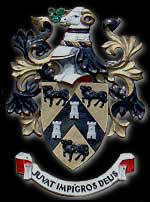
Coat of Arms of Huddersfield
Motto: 'God helps the diligent
Coates family name origins and coat of arms

The local craftsman builder that converted the buildings at Castle House
Farm into holiday cottages.
|
|
During the
Viking
period, 793-1066AD, Yorkshire and Northern England came under
Danelaw,
governed by the Danish Viking Empire.
Norman Conquest
The Norman conquest of England was the most important event in British
history and of our story as it led to the major change in land ownership
of England and the introduction of the
Feudal
system. Many of the
Saxon manors being given to
William the
Conqueror's supporters. Huddersfield was part of the Barony of Pontefract
bestowed on Ilbert
de Lacy.
In 1311 Henry de Laci died and his only heiress was his daughter Alice,
who had married Thomas, Earl of Lancaster, the manors of Huddersfield and
Almondbury became a part of the Duchy of Lancaster.
1399 and the manors of Huddersfield and Almondbury were passed to the
Crown Tudor to Modern Times
John Wode de Longley's daughter married William Ramsden in 1531, thus
starting the Ramsden association with Huddersfield which was to last
nearly 400 years.
In 1572, John Byron sold all the manor of Huddersfield to Gilbert Gerrard,
Queen Elizabeth the First's Attorney-General (who was probably acting for
the queen herself) for the sum of £975.
The Manor of Huddersfield was a Crown estate when Elizabeth the First sold
it to William Ramsden in 1599. The manor house was
Longley Old Hall
The Manor of Almondbury was acquired by the Ramsden family when they
bought it from Charles I. A map commissioned by the Ramsden family to show the extent of their
estate drawn c. 16/17th century shows that the land at Castle Houses was
farmed by a Richard Heaton from Upper Park. A baronetcy was conferred on
John Ramsden of Longley Hall and Byram in 1689 Huddersfield
became a
municipal borough in 1868 and the development as
a town during the 18th and 19th centuries was largely due to the Ramsden
family. Under their stewardship a master plan for the town was designed and they set the standard for the style and quality of
the ornate natural stone buildings described as "the second best example
of a planned town in the North of England".
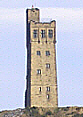
The town's most distinctive landmark, Victoria Tower was built on
Castle Hill in 1899 to mark
Queen Victoria's Diamond Jubilee as Monarch of the
British Empire.
In 1920 the Ramsden Estate was sold to Huddersfield Corporation for
£1,300,000, the sale
included most of the town centre and land within the Borough boundaries.
Huddersfield and the Estate were incorporated into
Kirklees, a new
Metropolitan Borough set up in 1974 under the Local Government
reorganisation act.
The oldest building at Castle House Farm is the
Laithe and from it's appearance, it was probably built c18th century.
Interestingly building experts believe that the roof trusses were recycled
from an even older building, the origins being unknown. The house was
built originally as two houses (Nos. 12 and 14) c1840 and attached to the
Laithe gable wall to the south. The site is reputed to have been last used
as a wood cutter's yard before 1900.
The Estate seems to have undertaken major refurbishment of their
properties at Castle Houses between 1897 to 1900 from records of residents
moving between properties at Castle Houses. The census during that era
list names and street of residence but not house numbers, however the
Burgess Roll of Huddersfield records give names and full addresses.
The roll of 1897/98 lists occupants as
12 - Henry Hirst
14 - Luke Earnshaw
24 - John Platt
In 1898/99 occupants include
8 - John Platt
24 - Luke Earnshaw
12 - John Wood
14 - No entry
1899/1900
22 - Luke Earnshaw
24 - John Platt
12 & 14 - no entries
1900/01
12/14 - Benjamin Coates
22 - Luke Earnshaw
24 - John Platt
1911/12
12/14 - John Coates, Benjamin is presumed to have passed away and
passed the tenancy to his second son.
From the movement of residents between different house numbers we surmise
that they were being relocated while major building works on the houses
were being undertaken.
We also know that the estate had decided to create a farm at Castle Houses
and build a range of farm buildings designed as a model farm together with
combining 12 and 14 into the farm house. These building works were
completed in 1900 and consisted of two continuous extensions on the north
and east of the Laithe to form a courtyard open to the south thus forming
a pleasant shelter from the prevailing south-west wind and from the east
and north winds in winter.
The buildings consisted of a
mistal for 20 cows, a two horse
stable and a
piggery containing two loose boxes. Two separate buildings, one a
cart shed and the other being a
tack room and toilet completed the range of buildings. 23 acres of
land was originally allocated to the farm but with later amalgamation of
farms this increased to a total of 144 acres by 1984. Coates
family and history and how they came to Castle House Farm
The history of how the Coates family arrived at Castle House Farm
has been handed down through the generations by the ancient tradition of
stories retold to each new generation and to my knowledge has never been
written down previously. Due to this method of recording family history
some details become vague, forgotten or misconstrued over time, so
we would appreciate information on any errors or gaps. Benjamin Coates was
born in the c1835 at Bloomer Hill Farm, a dairy farm situated just
outside
Silsden on Coates Lane, a small mill town between Keighley and Skipton in the West
Riding of Yorkshire.
Benjamin started farming in his own right by taking the tenancy of a dairy
farm at
Littleborough, now part of the Metropolitan borough of Rochdale in
Lancashire. The small, Pennine hill farmers made their living by servicing
the demand for fresh milk by the towns that grew up in the Pennines
following the Industrial Revolution. This was in the days before
refrigeration and mechanised vehicles. The milk was delivered to the
customer's door in a horse drawn "milk float". A "tap can" that held
probably about 20 gallons and was placed on the floor of the float, from
this a tap refilled the "delivery can" of about a gallon capacity and from
this the milk was measured out into the customer's milk jug by a one pint
or half pint measure, in local dialect a "milk ladle". Milk was
delivered twice a day in summer because of the lack of refrigeration.
Dairy farmers at this time increased the size of their business by moving
to a larger farm, consequently Benjamin moved to a tenanted Dairy farm at
Hollingworth, then part of Cheshire. His next move was to a farm at
Hollingworth Lake, back near to Rochdale. The story
goes that Benjamin was riding a horse through
Berry
Brow on his way to visit relations when he fell into conversation with
a local man who informed him that Ladyhouse Farm, on the outskirts of the
village was vacant. Benjamin applied for the tenancy and moved to
Huddersfield. The first written evidence we have of Benjamin is from the
1875/76 census recording him as living at Ladyhouse.
Benjamin and his wife Sarah had three children, Thomas b1871, Annie and John.
John was born c1883 at Ladyhouse and was quite a lot younger than his
siblings, indeed his mother was reported as saying that she didn't relish
having to wash nappies again at her age.
On 2 February 1900 Benjamin moved his family to the newly built Castle
House Farm, relinquishing the tenancy at Ladyhouse Farm to Joe Bates, the
two families have remained firm friends down to the present day. He also
took an additional tenancy of Lower Park Farm, this passed to his oldest
son Thomas and Castle House Farm was passed to John c1910.
John married Edith Harrison and they had three children Benjamin Walter
(Sonny), Thomas and Sarah. The two younger children both died in infancy.
Most of the farms in the area were termed as "flying herds". Because of
the limited acreage of the farms and the need to maintain production to
supply their milk rounds, the farmers bought newly calved dairy cows and
sold them when they were in the "dry" period, between calves to replace
them with another fresh calved cow. John developed a second business as a
cattle dealer to supply this demand from local farmers for fresh calved
cattle. He bought cattle from the rearing areas of Suffolk and the
Yorkshire Dales and for a short period from South West Scotland. The
in-calf dry cows he took in exchange he either sold on or farmed himself
until they calved again.
In 1940 Sonny married Bessie Hollingworth, daughter of the blacksmith in
Honley
and took over the tenancy of Castle House Farm. John succeeded the tenancy
at Lower Park from Thomas, who had no sons to follow him. Sonny and Bessie
had two children, John Philip (the present owner) and Judith
Isabel. Sonny carried on the twin occupations of dairy farmer and cattle
dealer. He sold the milk rounds in 1946 sending the milk to the
Milk Marketing Board. Dairy cattle sold to local dairy farmers were
sourced from the Yorkshire Dales, South West Scotland and occasionally
from North and South Wales depending on supply and demand. Sonny and
Bessie both passed away in 1991. Philip married Anne
McNeil in 1975 and after living in Berry Brow for three years moved back
to Castle House Farm in 1978. Anne's family originated from the
Isle of Barra,
traditional seat of
Clan
MacNeil They have three children, Jennie Elisabeth, James Benjamin,
Robert William and one grandchild Lukas Sonny. Philip became joint
tenant of the farm in 1967 and built the dairy herd up to a total of 100
cows plus rearing dairy replacements. 1997 marked the
start of a major depression in British agriculture, after a family meeting
it was decided that we could see no future for dairy farming and it would
be more prudent to sell while values were still relatively high than to be
forced to sell at a later date. The live and dead stock were sold by
public auction on 27 September 1997. Negotiations had already been started
with the estate to buy the property during the summer of 1997 and these
were brought to a successful completion on 29 March 1999, when the estate
agreed to sell Castle House Farm and about 16 acres of land in return for
relinquishing the remainder of the land for distribution among the
neighbouring tenants of the estate. After a period of research to find a
new use for the buildings John R Bradley Ltd of Horbury was asked to draw
up plans for converting the stone buildings to holiday cottages.
K J Brown
was appointed as builder and project manager and after receiving planning
permission, building work started on 29 September 2001. From the outset it
was decided to use only good quality materials and furnishings not only to
reflect our own tastes and preferences but also to maintain the standard
of excellence that Huddersfield has always been famous for. All visitors
to the cottages have appreciated the fine craftsmanship of the traditional
local tradesmen involved with the conversions. Stable cottage opened on 5
October 2002 followed by Mistal on 5 November and Laithe on 31 January
2003. No 2 Castle Houses was purchased on 29 May 2006 and named Sonny
cottage after Sonny Coates and because of it's sunny aspect. After
refurbishment this cottage opened on 21 July 2006. We
hope that you have enjoyed reading this history of Castle House Farm and
the people who have lived here. We hope that you will visit us soon and
come to appreciate this special place as much as we do and our many guests
from all parts of the world have and still continue to do so. |